Getting Grief Right by Patrick O’Malley
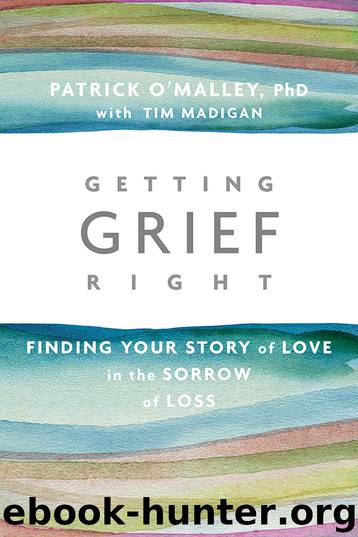
Author:Patrick O’Malley
Language: eng
Format: epub
Publisher: Sounds True
The role of attachment in grief can also be understood by its opposite — a lack of normal attachment. This is an important topic, though one I’ve seen very little written about.
Over the years, many clients come to me because they are confused that they do not feel more grief or that they are even relieved after the death of a loved one. Cases like this make up a small percentage of my practice, and they are almost certainly underreported because people are embarrassed by their feelings. Relief at the death of another sounds horrible.
There is indeed no Hallmark card of condolence that speaks to this subject. I have never heard a client discuss the feelings of relief, release, or emancipation regarding the death of a person close to them without confusion, shame, apology, or guilt. That’s understandable when you consider the ancient imperative of attaching to those in our tribe, particularly those initially responsible for our survival. When the ones who are supposed to be the safest for us are not, the natural order is disrupted.
This issue is known as complicated attachment, which exists on a long continuum. As I’ve said, every attachment story is unique, and rarely is attachment not complicated by the messiness of human relationships. Recall the story of Carol and Rebecca, the sisters from chapter 7. The two were frequently at odds, and their relationship ended on a very unfortunate note. But after Carol was able to work through her guilt, her deep attachment and love for her sister, as well as her grief, came to the surface.
But it’s different when the deceased had perpetrated overt physical or psychological abuse. The resulting relationships are devoid of love and attachment, even though they typically include family. Short of criminal abuse discovered by authorities, these relationships can be almost impossible to escape. A child is attached by blood to an abusive parent, but is not connected in the other, more life-affirming ways. Yet children don’t have the option to divorce their parents.
That feeling of there being no escape often leads to post-loss feelings of relief, guilt, anger, and confusion instead of sorrow. Another word that also comes up is emancipation. With death, those left behind are free of the oppression of an emotionally or physically unsafe relationship. But without help, it’s hard for a person in that situation to know what to do with feelings of emancipation, especially when the world says you are supposed to be sad.
Download
This site does not store any files on its server. We only index and link to content provided by other sites. Please contact the content providers to delete copyright contents if any and email us, we'll remove relevant links or contents immediately.
Doing It: Let's Talk About Sex... by Hannah Witton(9266)
Thirteen Reasons Why by Jay Asher(8874)
The Girl Without a Voice by Casey Watson(7870)
The Incest Diary by Anonymous(7661)
Should I Stay or Should I Go? by Ramani Durvasula(7639)
The Lost Art of Listening by Michael P. Nichols(7476)
The Leavers by Lisa Ko(6941)
The Space Between by Michelle L. Teichman(6911)
The Testaments by Margaret Atwood(6864)
The Four Agreements by Don Miguel Ruiz(6728)
Rich Dad Poor Dad by Robert T. Kiyosaki(6575)
The Rosie Project by Graeme Simsion(6353)
Beartown by Fredrik Backman(5717)
We Need to Talk by Celeste Headlee(5596)
Ego Is the Enemy by Ryan Holiday(5392)
Men In Love by Nancy Friday(5218)
Spare by Prince Harry The Duke of Sussex(5165)
Hunger by Roxane Gay(4910)
Suicide Notes by Michael Thomas Ford(4807)
